


Kitchen of the Week: At Home with a Couple Who Design Kitchens of Sustainable Bamboo
by Margot Guralnick
When you design and produce kitchens for a living, you get to use your own quarters as a testing ground. Kine Ask Stenersen and Kristoffer Eng are the couple behind Ask og Eng, the Oslo, Norway-based workshop known for its artful Ikea hacks: they specialize in making bamboo fronts for Ikea kitchen cabinets.
The duo also create their own fully custom kitchens, bathrooms, and furniture. After living with one of their very first Ikea upgrades, they decided to replace it with a bespoke design that showcases their bamboo finish. See Ikea Elevated for a look at their initial line, and join us for a tour of their kitchen.
Photography by Kine Ask Stenersen, courtesy of Ask og Eng.
 Above: The couple and their two young sons live in Drammen, Norway, in a 1930’s wooden house that they’ve made their own by taking down walls, installing French doors and windows, and exposing—and sanding and oiling—the original pine floor. The dining table is an Ask og Eng bamboo design, the A3 (sadly no longer available; browse their other bamboo furniture here).
Drammen is a 40-minute commute to the Ask og Eng workshop and showroom in Oslo. Kine and Kristoffer both grew up in Drammen—he’s an architect and she studied environmental geography (and brings a green mindset to their collaborations). Five years ago, they moved here from Oslo to be close to family, and say that it’s thanks to Kristoffer’s engineer father and his know-how and many tools (plus relatives ready to help with childcare), that they were able to get their company off the ground.
 Above: “The kitchen is visible from the living room, so we wanted it to resemble a piece of furniture,” says Kine. The cabinets are made entirely of bamboo inside and out; they extend from wall to wall—nearly 23 feet—and are in a just-introduced, vertical-grained Ask og Eng finish called Rye.
Their former kitchen, which they had “sawn, sanded, and oiled” in their garage, got disassembled and most of the parts have found new homes in other projects; many of the furnishings and appliances stayed put.
 Above: Step stools enable Vilmer, 5, and Artur, 1, to reach the counter of jura gray, a durable limestone patterned with fossils and shells. The induction cooktop is by Bora of Germany. The light at the end of the counter is the Accent Swing Wall Lamp by Remodelista favorite Wo & We of Lyon, France.
 Above: Kristoffer assists in waffle batter production.
 Above: Like all Ask og Eng kitchen designs, the drawers have cutout pulls and are fitted inside according to use.
Some of the advantages of working in bamboo, the couple say, are that it’s a fast-growing grass that’s lightweight and strong. They get their raw material from certified plantations “to be sure it’s not only sustainable but produced responsibly.”
 Above: A Birch Hook Rack keeps crucial kitchen tools off the counter. Discover more of the many uses for peg rails in our book Remodelista: The Organized Home, and for sources see Object Lessons: The Shaker Peg Rail.
 Above: All of Ask og Eng’s drawer and cabinet fronts are made of bamboo that’s been sanded, treated with pigmented oil, and sealed with a hard wax oil from Osmo to make them water- and spill-resistant. The sink has a Quooker faucet in patinated brass.
Of the overhead storage, Kine says, “The room is very sunny but we have a lot of dark periods here. To keep the space feeling open and bright, we decided against wall-hung cabinets and instead used our A7 Cross Shelf.”
 Above: To protect the limestone, there’s a collection of cutting boards on hand.
 Above: Kine and Artur. The couple were able to reuse appliances such as the dishwasher, concealed here behind a bamboo front.
 Above: Neff wall ovens are incorporated into a pantry wall. The Ask og Eng A7 Cross Shelf comes in large (shown here) and small (shown over the counter).
 Above: There’s a breakfast table and &Tradition’s rice paper Formakami Pendant tucked into a corner next to the fridge.
 Above: Gubi’s now-classic Semi Pendant from 1968 hovers above the dining table. (See the light in brass in A ‘Dreamiest Dream Kitchen’ in Yorkshire, England.)
 Above: The kitchen viewed from the living room.
Here are some other standout kitchens that designers created for themselves:
- An Architect’s Own Custom Kitchen in London
- A Designer’s Ikea Hack in Provence, Before and After
- An Architect-Designer Couple’s Own Cottage Kitchen in Los Feliz
N.B.: This story originally ran on March 5, 2020 and has been updated with new information and links. Follow the couple on Instagram @askogeng to see their more recent quarters in Mallorca.
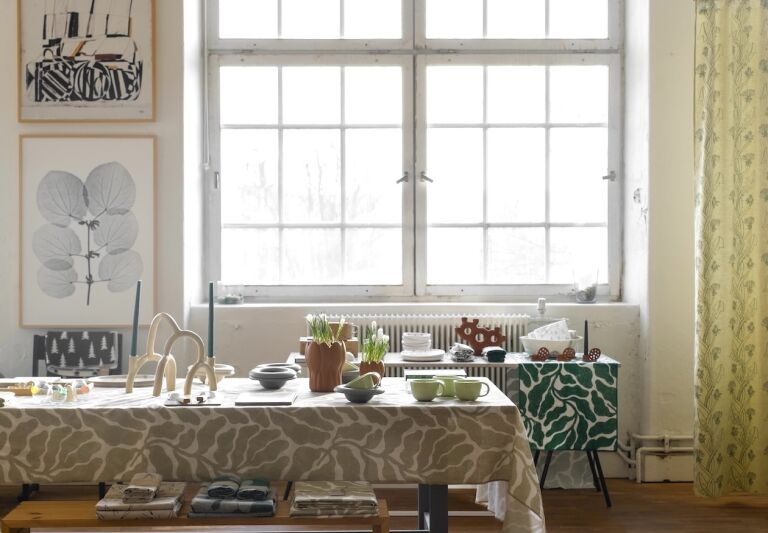
“Objects with Actual Personality”: Posters, Patterned Fabrics, and More at Fine Little Day
by Margot Guralnick
Swedish artist/photographer Elisabeth Dunkel was finishing her masters’s in design when she began posting snapshots of daily delights: pine needles, paper dolls made with her kids, a collage of photo booth portraits, a pink cuckoo clock. Fine Little Day, as Elisabeth dubbed her blog in 2007, quickly attracted a lot of fans. And led her to start producing and selling some of her own prints and fabrics. Finding too many hours of her fine little days spent packing orders, Elisabeth soon wanted out.
When she asked Ulrika Engberg, an entrepreneurial design school friend, to buy her business, Ulrika instead proposed teaming up. That was 15 years ago and together Elisabeth and Ulrika have grown Fine Little Day into a thriving housewares brand that celebrates, in Elisabeth’s words, “colors on the walls, patterns in every corner, and objects with actual personality.” They produce their own lines of posters, home textiles, and interior accents designed by Elisabeth and a stable of artists and makers. Their test lab is their showroom in a converted historic mill building outside of Gothenburg, Sweden. Join us for some browsing.
Photography by Elisabeth Dunker, unless noted, all courtesy of Fine Little Day (@finelittleday).
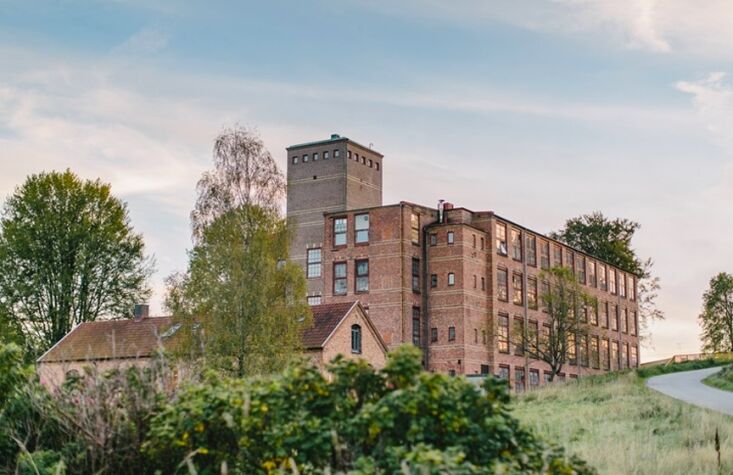 Above: Fine Little Day is located in the 19th century brick Spinneriet building, a former spinning factory in the countryside in Lindome, Sweden. Photograph by Hilda Grahnat.
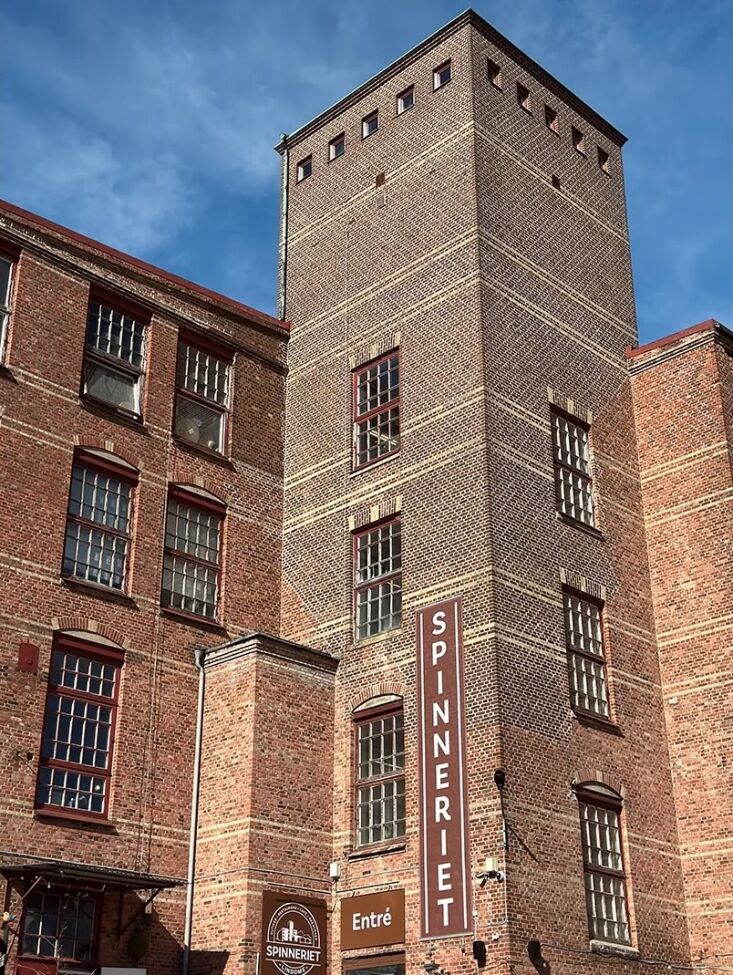 Above: A model of 1990s creative reuse, the building houses a number of indie design stores, a combination record shop/recording studio/cafe, and its own restaurant.
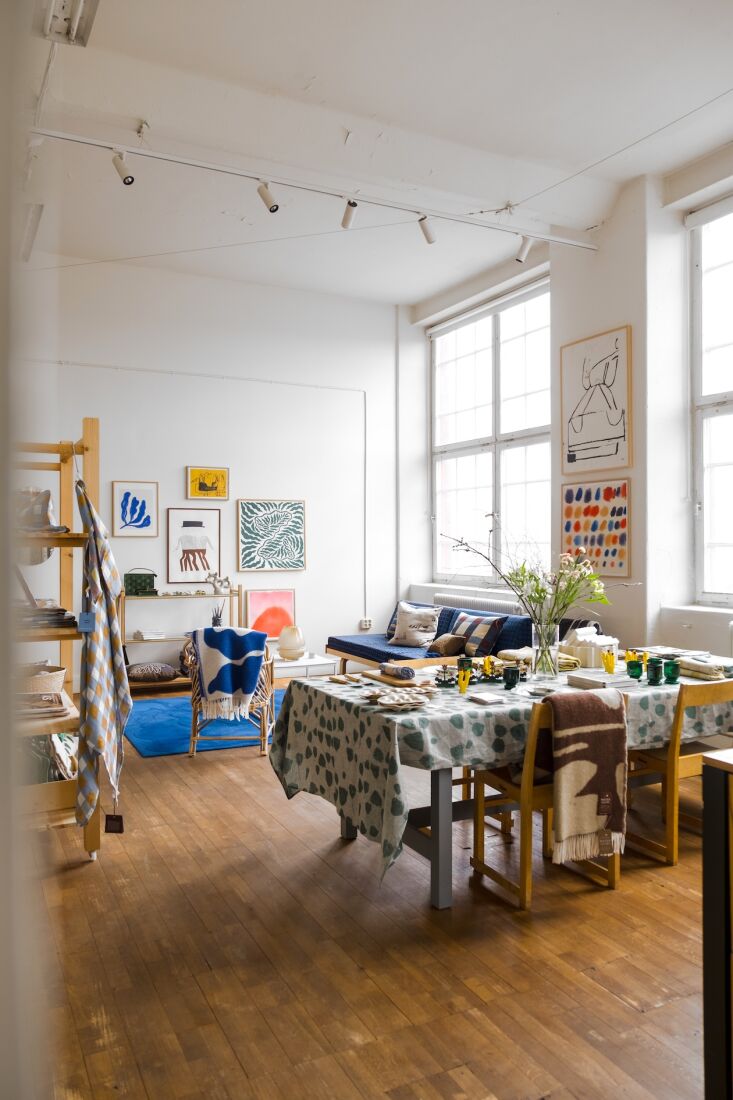 Above: How to live the Fine Little Day way? The gallery serves as a guide. Among the FLD designs shown here: a Bouquet Linen Tablecloth; $214, Large Water Lillies Wool Blanket, $266; and Colors Poster, $90.
Fine Little Day wares are also available in boutiques around the world and from the brand’s online shop. The company is sustainability minded and tries to stick with natural materials. Its designs are produced by workshops all over—the blankets, for instance, are listed as “woven in the EU of Oeko-Tex Standard 100, Woolmark, and Wool Integrity NZ-certified New Zealand new wool.”
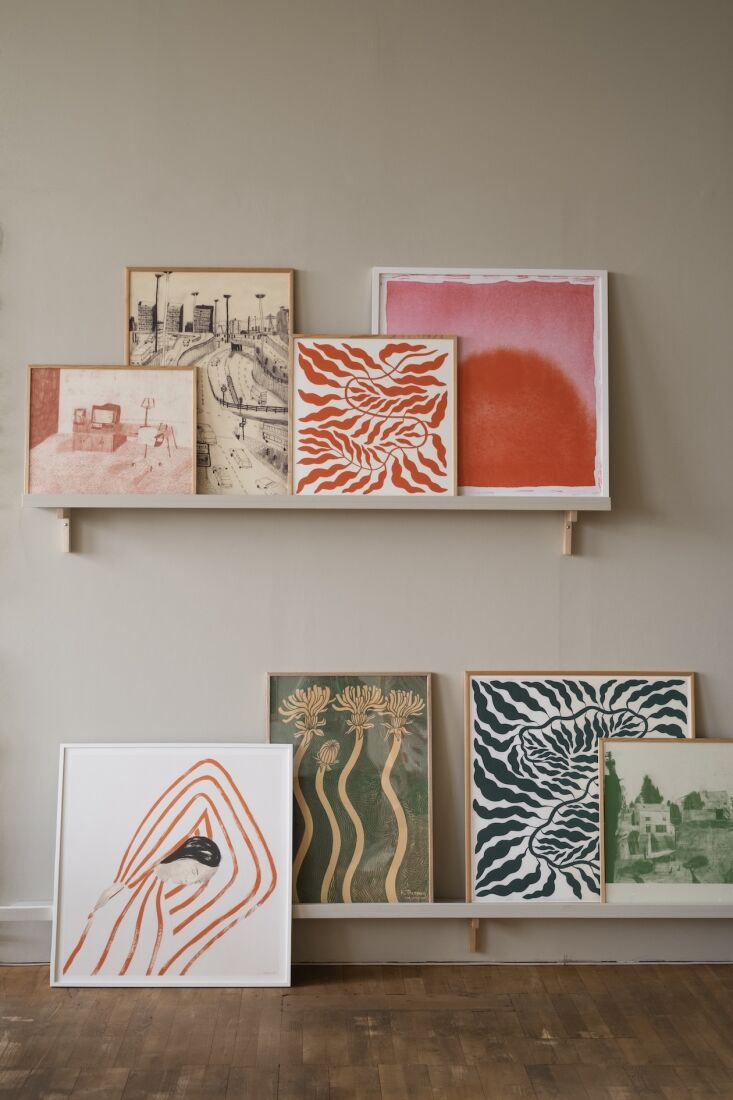 Above: Elisabeth’s approach to creating a poster wall: “No rules. Just layers, accidents, things that refuse to match but somehow still do.” The prints shown here include the Orange Red Leaf Poster, $48; Sun Poster, $69; Own Strokes Poster, $51; and Kristine Thenman Makros Poster, $63,
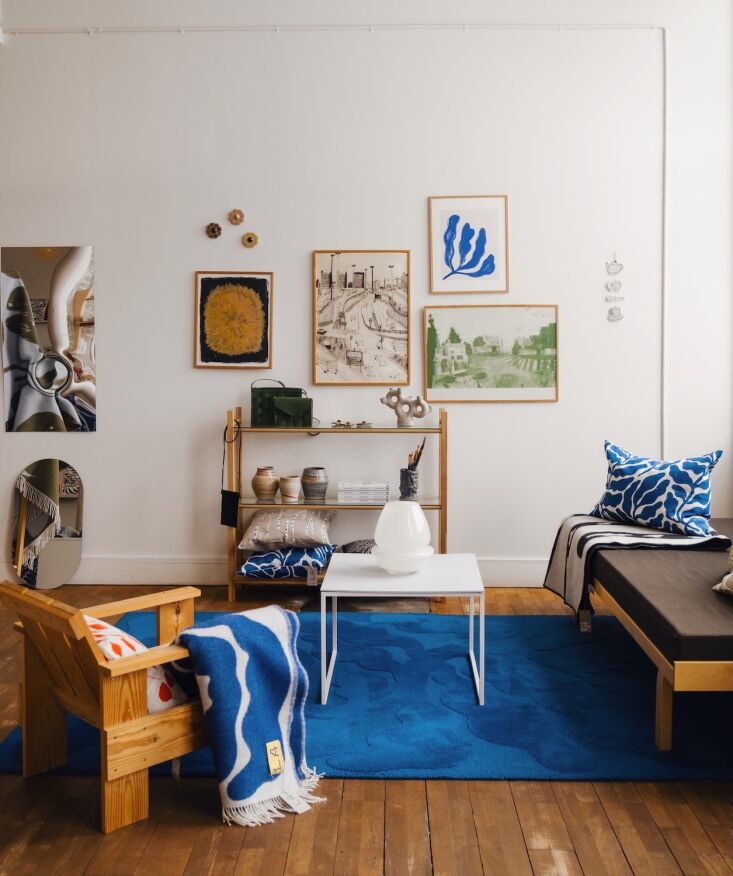 Above: The sitting area is anchored by local artist Linnéa Andersson’s companion designs: her Leaves Large Wool Blanket, $266; Bloom 1 Poster, $48; and Leaves Cushion Cover, $86.
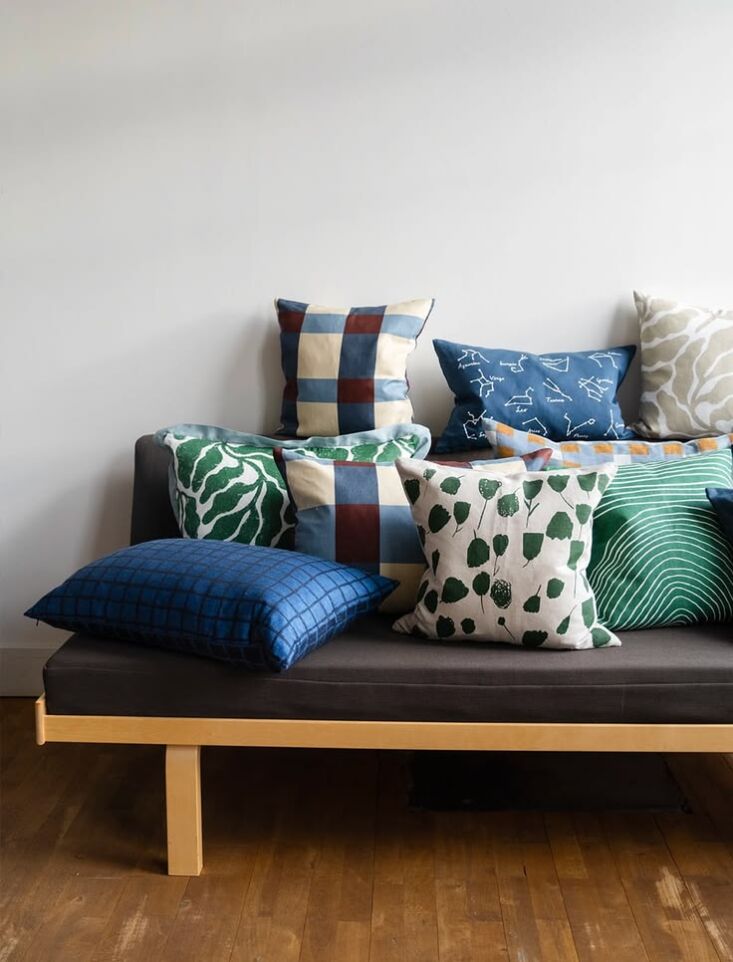 Above: Evelina Kroon’s Field Cushion Covers, $71; Isis Maakestad’s Green Bouquet, $65. and more from Fine Little Day’s large selection,
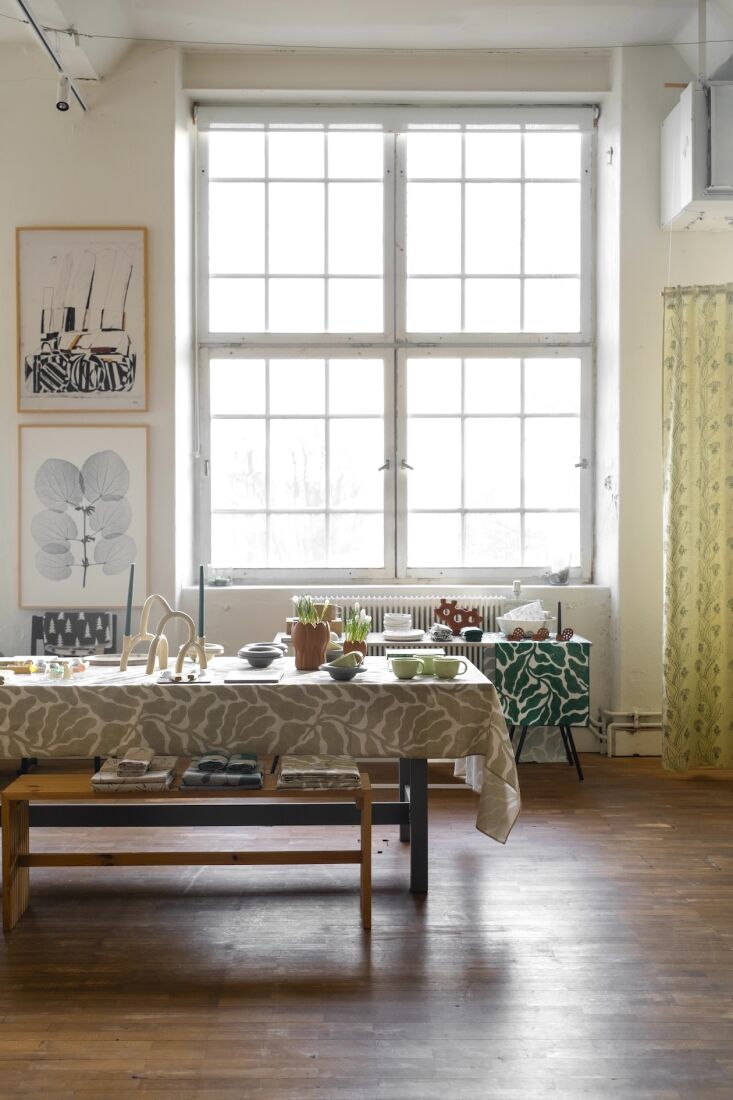 Above: A Leaves Linen Tablecoth in Sand, $203, and Leaves Linen Runner in green, $71, in the in-house dining room.
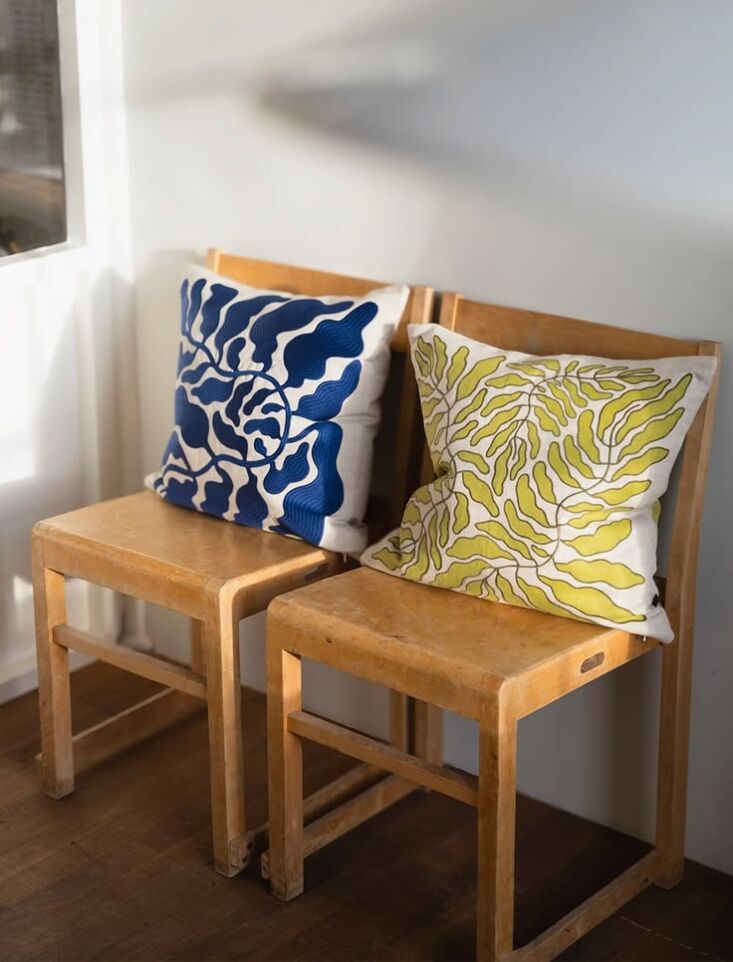 Above: Linnéa Andersson’s made-in-India Leaves Embroidered Cushion Covers in blue and lime, $80 each.
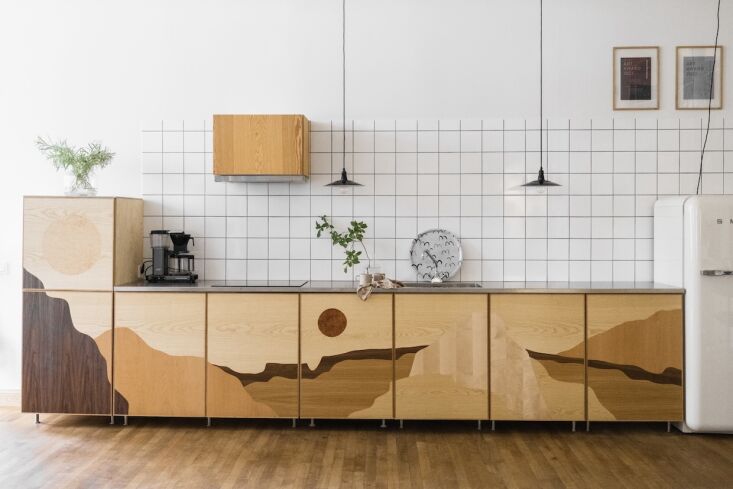 Above: The shop kitchen was given a makeover by 35-year-old designer/carpenter Carl Martinsson, Fine Little Day’s art award recipient of 2024. Elisabeth says the prize—which they grant themselves, without soliciting applications and includes an exhibit in the showroom—”recognizes practitioners in art, design, and craft, whose work deserves to be seen; Carl’s is a perfect example: every detail is considered.”
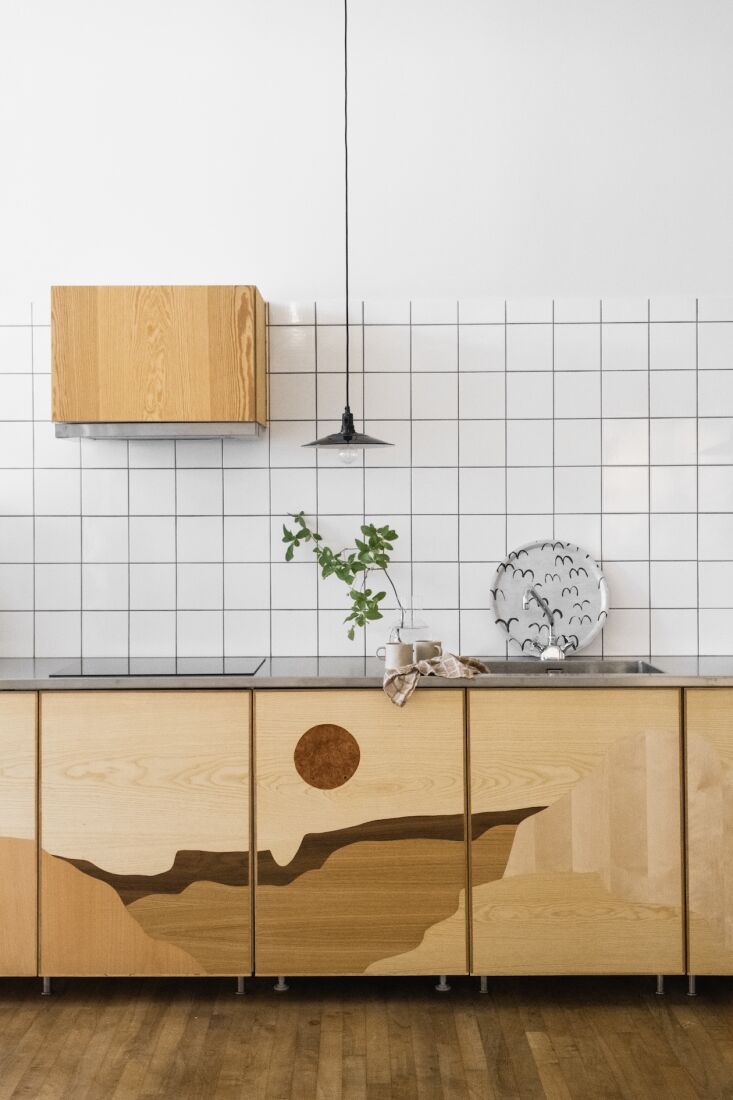 Above: Martinson, who is based in Gotland, uses the centuries-old wood inlay technique of intarsia to create his 1970s-esque landscapes. The black and white Bird Tray, $51, designed by Elisabeth, is part of Fine Little Day’s large collection of laminated birch plywood serving pieces. (See more in 8 Favorites: Scandinavian Trays, a Midcentury Design Star that’s Back on the Table.)
 Above: Fine Little Day co-directors Ulrika E. Engberg (L) and Elisabeth Dunker (R). They’re both wearing tops made of Fine Little Day linen: Rutig in Blue/Black, $110 a meter, and Field Linen in Blue/Plum, $80 a meter. Photograph by Cecilia Magusson.
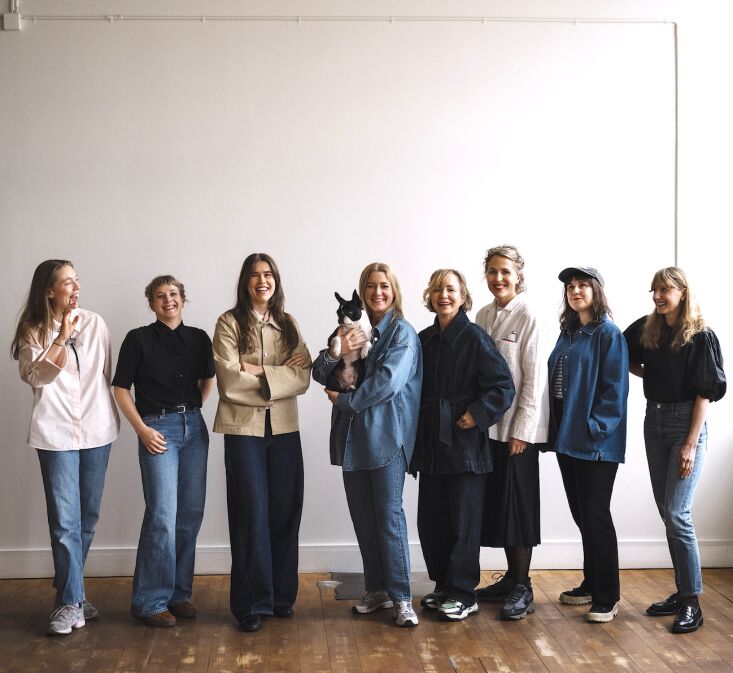 Above: The Fine Little Day team. The company’s motto: “creating, discovering, and spreading the word about art, design and sustainable products since 2007.” Photograph by Cecilia Magnusson.
The Spinneriet building is located at 2 Spinnmästarevägen in Lindome, Sweden, just south of Gothenburg.
We recently spotlighted Elisabeth’s Gothenburg family apartment: Making a Rental Your Own.
For daily dispatches and more favorite finds, head to Remodelista.com. For bonus content—like our weekly Quick Takes column—consider joining us as a paid subscriber.
Remodelista participates in affiliate marketing programs, which means we may get paid commissions on products purchased through our links to retailer sites.
