


Expert Advice: 8 Tips for Staying Cool Without AC
by Annie Quigley
Call me crazy, but I don’t love AC. I grew up without it, and to this day, I like the simple nostalgia of keeping cool in other ways: Bedside fans and open windows harken back to summer nights at camp or in the beach cottage, and I am also a fan of no-cook popsicle dinners. Of course, sometimes AC simply isn’t an option, even when it’s really needed.
With that unplugged spirit in mind, we asked Jeremy Floto and Josh Farley, the one-time designers and proprietors behind The Glen Wilde, a throwback 1940s bungalow community in the Catskills, for their tips on keeping cool. Sadly, The Glen Wilde has closed its doors since we first ran this story, but the tips still ring true.
Here are eight ways to beat the heat the good old-fashioned way.
Photography courtesy of The Glen Wilde.
1. Blow the hot air out.
 Above: No-fuss folding wood chairs in one of the bungalows.
To keep a room cool without AC, “it’s all about air circulation,” Floto and Farley say. “Blow the hot air out and bring the cool breeze in.” The Glen Wilde bungalows are outfitted with exhaust fans in the ceiling that pull the hot air up and out. Don’t have an exhaust fan built in? You can use a simple box fan: It sounds counterintuitive, but a fan pointing out the window, rather than toward the room, will “act as an exhaust fan and suck out the hot air,” the proprietors say.
2. Close the windows during the day.
 Above: A summer table, flowers included.
When it comes to opening and closing windows, timing is key. Close the windows (and the shades) in the morning to keep the cool air in during the heat of the day (and keep the sun out).
3. Then, open them at dusk.
 Above: Vintage fans sit atop dressers in the bungalow bedrooms.
The reverse is true at night: “As dusk approaches, open your windows to let in the cool night air,” Floto and Farley say. Be sure the windows are screened to keep the bugs out.
4. Stock up on fans—and know how to use them.
 Above: Another vintage fan, in blue.
On hot, still nights at the Glen Wilde, Floto and Farley open the windows all the way and position a fan in the window frame: “That way, the fan will suck in the cool air from outside while also creating a breeze,” they say. Or keep a bedside fan on hand, like the vintage fans in each Glen Wilde bungalow, and point it at the bed at night to “simulate an ocean breeze.”
5. Strip the bed.
 Above: A bungalow bedroom with cotton sheets.
For a cool night’s sleep, bring your bed back to basics. “For bed linens, we use 100 percent cotton,” Floto and Farley say. “Even though it’s hot up here during the day, since we’re in the mountains it cools off at night. We’ve found that the cotton/poly blend might be nice for superhot days, but overall the 100 percent cotton has good skin feel while still staying cool enough.” (They also air-dry sheets the old-fashioned way.) Instead of a quilt, Remodelista editors are known to use a simple sheet, draped across the bed, as a light top layer.
6. Dampen a sheet.
 Above: A vintage twin bed in one of the bungalows.
On particularly sweltering nights, invoke what’s sometimes known as the “Egyptian method:” Lightly dampen a top sheet with cool water and lie underneath it. (We like the idea of keeping a glass spray bottle at the bedside for easy dampening.)
7. Sit—or sleep—on the porch.
 Above: A screened porch with interior cladding, painted green.
“Back in the day”—when Catskills summer communities were in their heyday—”the bungalows had sleeping porches,” Floto and Farley say. Make use of screened porches to catch a breeze, bug-free, at all hours of the day—or position a bed on the porch for an ideal summer night’s sleep.
8. Maximize shade.
 Above: Dinner outdoors at the bungalow colony.
When it comes to keeping a house cool, think about what’s outside as well as in. Planting shade trees or shrubs, depending on your area, will “shield the exterior from the hot sun.” The Glen Wilde bungalows benefit from stands of trees for outdoor meals in the shade.
 Above: One of the cottages at night.
When all else fails, try these DIYs from our post, 7 Tips for Getting a Good Night’s Sleep in Summer: “Try taking a cold shower before going to sleep and place a damp washcloth next to the bed. For more relief, make a rice sock: Fill a fresh sock with rice and tie it with a ribbon at the top. Place it in the freezer for a few hours and rest it around your neck or on your forehead as a cooling compress.” Or, simply put a washcloth in the freezer to cool it down for a bit.
For more expert summer insight from the Glen Wilde folks, see Expert Advice: How to Open Up the Summerhouse for the Season.
N.B.: This post is an update; the story originally ran on August 11, 2017.

Kitchen of the Week: A Designer’s Deconstructed Sonoma Kitchen from Reclaimed Parts
by Annie Quigley
File this under When the Whole Is Greater than the Sum of its Parts:
Ever since Julie first took a tour of San Francisco designer Charles de Lisle‘s reclaimed retreat in Sonoma (see: Off the Grid: A Stylish, Low-Impact Retreat in Sonoma by Charles de Lisle), we’ve been admiring how it manages to be simultaneously low-impact on the earth and high on style—putting to bed any notions that the eco-conscious can’t be aesthetically appealing.
Today we’re taking a closer look at de Lisle’s kitchen, made entirely from salvaged standalone pieces. Taken alone, each part—an old laundry sink, a reclaimed work table—might not seem like much. But with de Lisle’s discerning eye they’re transformed into something fresh and efficient.
Photography by Eric Petschek.
 Above: The retreat, which de Lisle shares with his partner, Studio Volpe designer Ralph Dennis, is made up almost entirely of reclaimed and eco-conscious parts: plywood cladding, vintage windows salvaged from an Air Force base, and solar panels on the roof. The light-filled main room has a sitting area and Jøtul stove on one end.
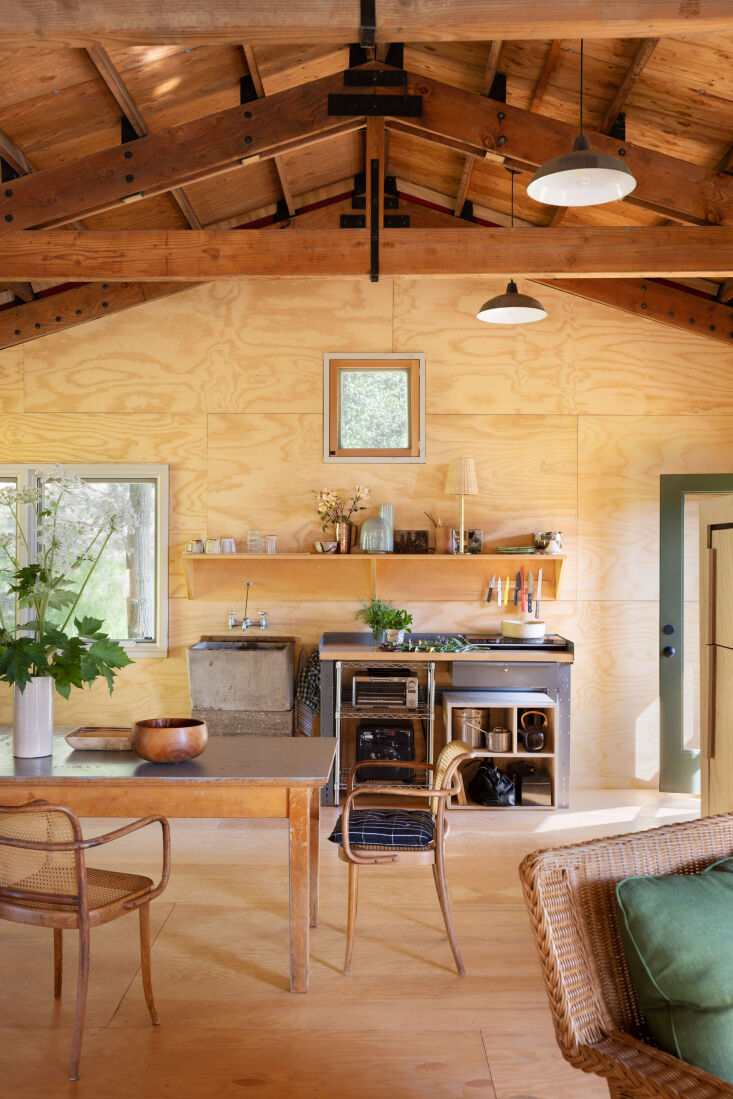 Above: At the other end is the efficient kitchen, stripped of the extraneous but not of style. The cast-concrete laundry sink was repurposed from the original cabin, paired with a no-fuss stainless steel work table from Grainger that houses a cooktop and toaster oven. The wall-mounted faucet is from Kohler, and the dining table is a vintage workbench originally rescued by de Lisle’s father. A plywood shelf overhead frames the workspace and holds ceramics.
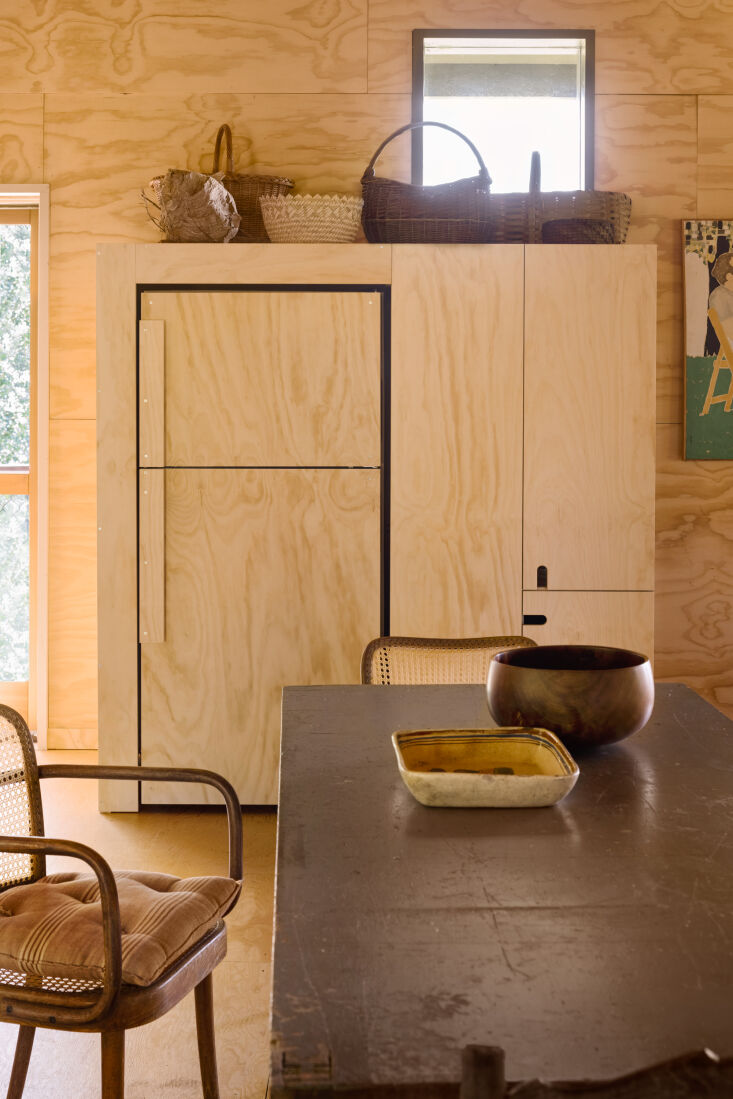 Above: The fridge was repurposed from de Lisle’s San Francisco workspace and given a makeover. Fronted entirely in plywood, it takes on the look of a built-in cabinet.
 Above: For a full tour of the off-grid retreat—including the Japanese cedar soaking tub for bathing al fresco—see Off the Grid: A Stylish, Low-Impact Retreat in Sonoma by Charles de Lisle.
And for more off-grid kitchens—and houses—we like, see:
- An Off-the-Grid Retreat Designed as “a Piece of Furniture with Everything Built In”
- Kitchen of the Week: A Small Off-Grid Kitchen in an Architect-Designed Guest Cabin
- Kitchen of the Week: 6 Low-Impact Deconstructed Kitchens
N.B.: This story originally ran on January 19, 2023 and has been updated.
For daily dispatches and more favorite finds, head to Remodelista.com. For bonus content—like our weekly Quick Takes column—consider joining us as a paid subscriber.
Remodelista participates in affiliate marketing programs, which means we may get paid commissions on products purchased through our links to retailer sites.
